News
UAE President’s Fraternal Visit to Kuwait: What Does This ‘Fraternal Visit’ Mean for UAE–Kuwait Relations and the Gulf Economy?

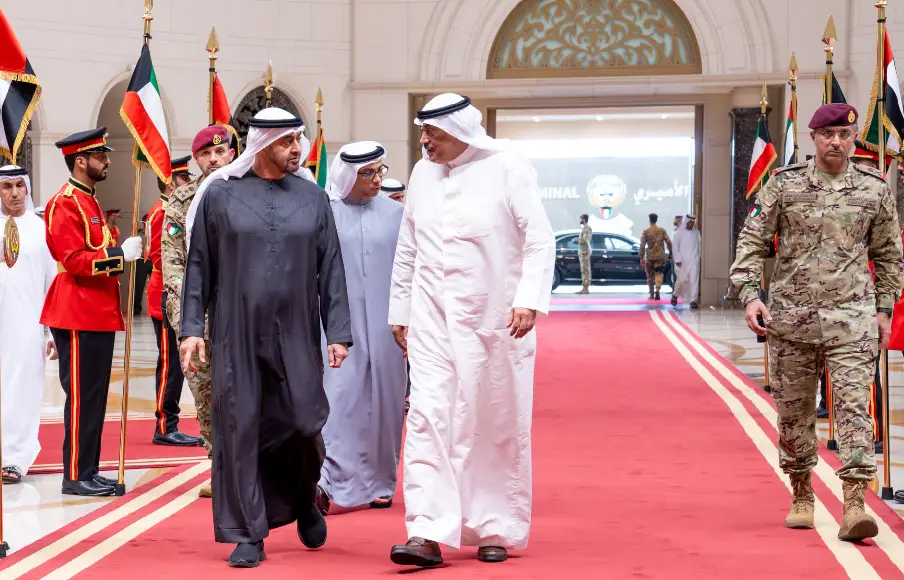
His Highness Sheikh Mohamed bin Zayed Al Nahyan, president of UAE arrived in Kuwait on a fraternal visit, signalling the close historical and strategic ties of the two Gulf countries. His Highness expressed the value each country places on their partnership and was met by His Highness Sheikh Mishal Al-Ahmad Al-Jaber Al-Sabah, Emir of Kuwait, and His Excellencies of other top officials from the Kuwaiti leadership.
The UAE President is accompanied by a high-level UAE delegation, which comprises Sheikh Mansour bin Zayed Al Nahyan, Sheikh Saif bin Zayed Al Nahyan, and Sheikh Hamdan bin Mohamed bin Zayed Al Nahyan. This presence of key leaders underscores the wide spectrum of the cooperation between the two countries in the political, economic and security fields.
What Does a ‘Fraternal Visit’ Mean?
A fraternal visit during the Gulf diplomacy is not just a “ceremonial” one. It indicates the close and profound ties between the neighbouring countries that share a long and deep history, a common culture and interests and are members of the GCC. These meetings can be useful for building trust, discussing local conditions and deepening understanding and engagement of shared issues.
While state visits typically have an agenda dominated by formal discussions about accords, fraternal visits tend to focus more on maintaining close leadership ties and on long-term strategic coordination. They also convey a powerful message of unity and solidarity in the Gulf area.
Strengthening UAE–Kuwait Relations
The UAE is and has been a close trading partner, investor and ally to Kuwait in various fields, and both nations have recently committed to deepening their engagement beginning in the fields of trade, investment, energy and security and humanitarian work over the past decades. There are regular high-level meetings that facilitate the cooperation between the two States regarding the priorities of the region on stability and economic diversifications and sustainable development.
Both countries have ambitious national development plans and new opportunities will arise if their cooperation is strengthened, especially in the field of infrastructure, renewable energy, logistics, digital innovation and in tourism. These partnerships complement wider ones which are attempting to diversify the economies of the Gulf beyond oil.
Impacts to the Gulf Economies
The cooperation between UAE and Kuwait also holds larger significance in regard to the regional economy. Both of them know an influential role in the GCC region as well as they contribute and both countries remain an important contributor of trade and investments and financial markets in the Middle East sphere.
Better bilateral cooperation can help make investment more attractive, boost cross-border business links and help in developing regional infrastructure and connectivity initiatives. Ongoing dialogue between Gulf leaders also contributes to a more favorable economic climate that is key to bringing in foreign capital and strong long-term growth prospects in the region.
Looking Ahead
The UAE President’s visit underscores the UAE-Kuwait age-old partnership, and the UAE’s and Kuwait’s desire to continue working together for regional cooperation and prosperity. The rise in the levels of such meetings continues to be a vital venue for reinforcing the partnership between the two countries and the GCC region, both for their mutual interests and for the region’s economic development, including the diversification of the economies of the Gulf states.




UAE Foreign Minister Sheikh Abdullah Holds Talks With Russia’s Lavrov

GCC Houthi designation urged by Gulf ministers

Abu Dhabi Introduces My Home is Safe Initiative for New Home Handovers

Damascus Reaffirms Syria Support for Riyadh Amid Houthi Attacks

Qatar Engages in Global Cybersecurity Talks at Singapore Cyber Week

Fujairah Coast Hit by Minor 1.6 Magnitude Tremor
-

 Entertainment1 week ago
Lusail Circuit Opens Volunteer Applications for 2026 MotoGP and Formula 1
-
 Reports1 week ago
UAE and Saudi Arabia Seek to Strengthen Rail and Infrastructure Integration
-
 Reports1 week ago
Kuwait Urges Unified Global Response to Terrorism and Financing
-
 News1 week ago
Etihad Suspends Riyadh Flights After Houthi Attacks