Ethiopia’s Hayli Gubbi volcano exploded with explosive force after being quiet for almost 12,000 years, sending huge clouds of ash into the sky and affecting flight paths around the world. New pictures from satellites show that the scenery around the volcano has changed a lot. These changes show how big and strong the volcano’s sudden eruption was. For more news updates, visit our Gulf Independent News page.
A Sudden Outbreak After 12,000 Years
The volcano’s long period of inactivity meant that regional tracking agencies were not expecting the eruption that began earlier this week. Seismic stations in the Afar region first noticed tremors. Then, a strong explosion followed, sending clouds of ash thousands of meters into the sky.
Scientists say that the eruption looks like a phreatomagmatic one, which is a powerful reaction that happens when magma meets water underground. This reaction raises explosive pressure, creating huge clouds of ash like those in the 2010 eruption of Eyjafjallajökull in Iceland.
The Scale of the Damage is Caught by Satellites
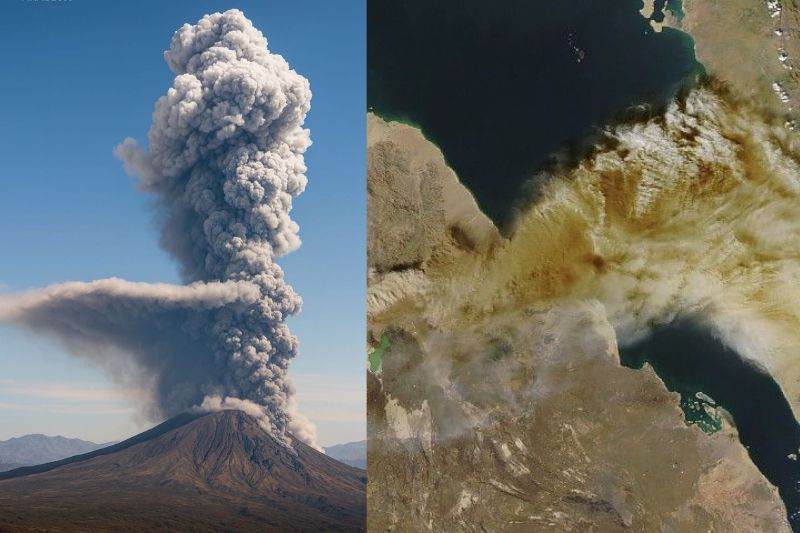
Global space agencies have shared high-resolution pictures from satellites that show clear marks across the volcanic ridge.
The pictures show:
- Fissures and cracks that have just formed
- Dark ash that has built up over many kilometres
- Changes in the ground that happen quickly
- The volcanic smoke spread as strong winds pushed it to the west.
Thermal readings show that lava movement is still happening, which makes the remote-sensing community think that another eruption could happen.
Global Flight Paths Changed
When the ash cloud moved into important flight paths over East Africa and the Middle East, authorities warned of the highest level of danger. Several long-haul trips between Africa, Europe, and Asia were sent on different routes so that the planes’ engines would not be damaged by ash.
Airlines flying through Addis Ababa, Nairobi, Dubai, and Jeddah had delays. Meteorologists said that changing winds could cause “intermittent disruptions” for several days.
Local Communities Get Ready for Impact Local villages close to the volcano had to be temporarily evacuated because of heavy ashfall, and masks and water had to be quickly given to the people who lived there. Ash particles are very bad for your health, so officials have told people to stay inside.
In the Afar area, environmental teams are keeping an eye on possible changes to grazing land, crop fields, and bodies of water that are important for the people who live there.
Rare Geological Event
Geologists from many different countries have said they are shocked.
It’s very odd for a volcano that hasn’t erupted in 12,000 years to suddenly become active again.
Scientists think that the East African Rift’s tectonic action may have caused the event. Hayli Gubbi is in a rift valley system where the African continent is slowly breaking apart. The system is very active.
Experts are still trying to figure out if this eruption is the start of a longer volcanic phase. With constant tracking from satellites, it will be possible to keep track of:
- Changes in the height of the plume
- Unusual temperatures
- Possible formation of lava flow
- Along the gap, new breaks are appearing.
Aviation alerts are still in place for now, and officials are making plans in case they need to respond to more action.




 Top Stories2 weeks ago