News
Beyond Donations: How the United Arab Emirates Built a Rapid-Response Humanitarian Model During the Gaza Crisis

The extent of humanitarian assistance provided by a country is no longer the only criteria for measuring human rights’ impact during contemporary conflicts. As the savable with it is more and more shaped by the speed with which corresponding support is mobilized, coordinated and provided during extreme operational conditions. In the Gaza crisis, this distinction became very pronounced.
There were various regional responses, diplomatic, political or financial, with the UAE’s participation in a much more comprehensive operational capacity – humanitarian aid, medical infrastructure, interventions, logistics, and multilateral diplomacy.
This put the country not just in position as a donor but as a fast response country in the humanitarian sector.
Moving Beyond Traditional Aid
Strategies responded to Gaza in various ways. Through the port of Rafah, Egypt was an important geographic gateway. One of Jordan’s concerns was Emergency Air drops and Relief Corridors. Qatar took center stage for the mediation and Saudi Arabia and Turkey focused on diplomatic positioning and political advocacy.
But the model followed by the UAE was more integrated. Instead of making the separation of the provision of aid from its implementation, it had a combination of both. The humanitarian convoys, relief flights, sea shipping, medical assistance and evacuation programmes all happened at the same time: a multi-layered response infrastructure emerged.
Humanitarian Logistics as Strategy
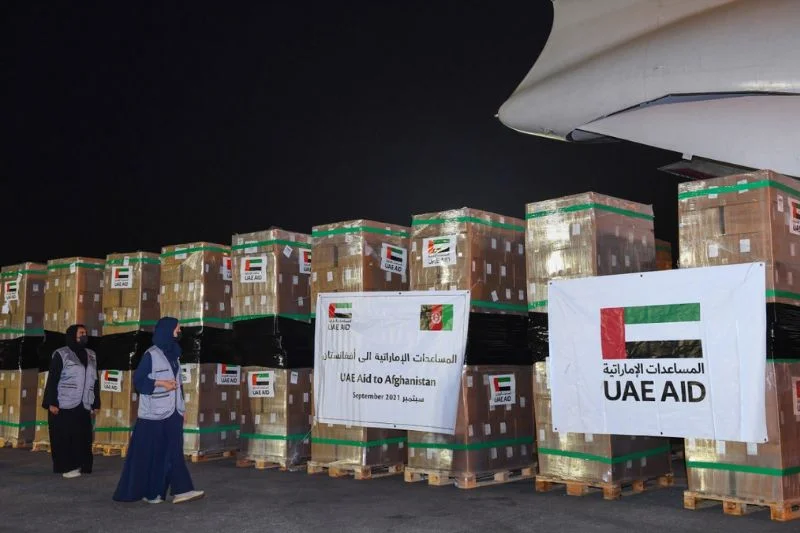
An aspect of the UAE response that stood out was its focus on logistics. Aid can be delayed in conflict situations due to damage to country infrastructure, security barriers, and coordination issues. The UAE has made substantial investments to surmount these bottlenecks to achieve transportation flexibility through multiple delivery mechanisms including air, land and sea.
Air operations continued to increase in pace as medical and relief supplies were transported from one area to another, and large-scale aid convoys transported through regional logistics hubs. The maritime transport also provided more resilience to the humanitarian supply chain and ensured the delivery of humanitarian assistance despite ground situation changes.
This was in keeping with the growing realization of the need in modern crises not only for financial support but also for logistic capacity.
Hospitals, Evacuations, and Medical Infrastructure
One of the UAE’s most noticeable acts of response was in their health sector. It has set up a floating hospital in the vicinity of the war zone to broaden treatment capability, as well as a field hospital for patients from Gaza.
These facilities provided immediate health care needs during emergencies while setting the base for a sustainable medical support to civilians, who were injured by the conflict.
Medical evacuations were another key pillar of the response effort. The wounded civilian population, including children and critical patients, was rushed to foreigners for specialized care, thereby making humanitarian support not only an intervention, but also a healthcare pathway. Humanitarian support ceased to be an intervention, becoming an active healthcare pathway for wounded civilians, including children and critical patients, who were brought on board and taken abroad, for specialized healthcare.
Diplomacy Through Humanitarian Channels
The UAE’s involvement was not only operational relief but was also impacting international diplomacy as well. The country had an active role in the United Nations Security Council to champion humanitarian access and speed up humanitarian assistance to Gaza.
This exemplifies another key element of the Emirati strategy: a marriage of ‘field work’ and institutional diplomacy. The UAE pursued a comprehensive approach to humanitarian assistance and diplomacy, rather than considering them separate, as a coordinated crisis-response approach.
Maintaining Engagement Amid Regional Tensions
The Gaza conflict took place as the local landscape continued to polarize or become interwoven with political narratives, with humanitarian actions being increasingly intertwined. The UAE continued to be operationally engaged during the same period and emphasized on relief delivery, civilian support and institutional coordination messaging.
This enabled it to maintain multiple channels of relations as it continued with large scale humanitarian operations even amidst growing geopolitical tensions.
Rise of a Rapid-Response Humanitarian Hub
The Gaza crisis was indicative of a more significant shift in the UAE’s international image. During the past ten years, quickly and effectively mobilizing infrastructure at regional level – logistics networks, aviation support, medical deployment networks, diplomatic coordination mechanisms – has been gradually developed.
The overarching result is a model that is distinct from the donor-state model. While engagement may only involve financial support, the UAE has begun to function as a humanitarian logistics platform that can provide humanitarian assistance, medical aid and diplomacy alongside each other.
Explore More Must-Reads
What Drives Vision 2030 EV Growth?
Explore how electric vehicles are shaping a greener GCC future under Saudi Arabia’s Vision 2030 initiatives.
Which Mega Projects Lead Vision 2030?
Discover the most ambitious mega projects transforming Saudi Arabia’s landscape and economy.
How Budget 2026 Supports Vision 2030?
Check how Saudi Arabia’s 2026 budget fuels growth and revenue under Vision 2030 plans.
How Vision 2030 Changes Gulf Jobs?
Explore how Vision 2030 is reshaping job markets and career opportunities across the Gulf region.
What Defines Riyadh’s Vision 2030 Lifestyle?
Discover how urban development is transforming lifestyle and living standards in Riyadh.


UAE’s Confidence Capital: Why Global Investors Are Looking Beyond Property

Back-to-School: Things Parents Should Check Before Choosing a School

UAE Leaders Meet Bahrain’s King Hamad in Dubai to Strengthen Bilateral Ties

How to Join UAE School Uniform Swaps and Book Exchange Groups in 2026

Saudi Arabia Sets 30-Day Deadline for Employers to Notify Job Applicants

Houthi Attacks Wound 73 Civilians in Saudi Arabia’s Southern Regions
-

 Reports1 week ago
Saudi Arabia and Syria Establish Joint Bank to Boost Investment and Economic Ties
-
 News1 week ago
Qatar Names 243-Athlete Team for Aichi-Nagoya 2026 Asian Games
-
 Reports1 week ago
Makkah Defense Pact: Strategic Committee to Hold First Meeting in Istanbul
-
 Sports1 week ago
Messi Is Leaving Argentina But He Isn’t Retiring From Football Yet